
Last updated September 20, 2026
Free on-site gate assessment - hinges, posts, and your LiftMaster or Nice gate operator checked before anything is quoted
The assessment is free and the quote is the invoice.
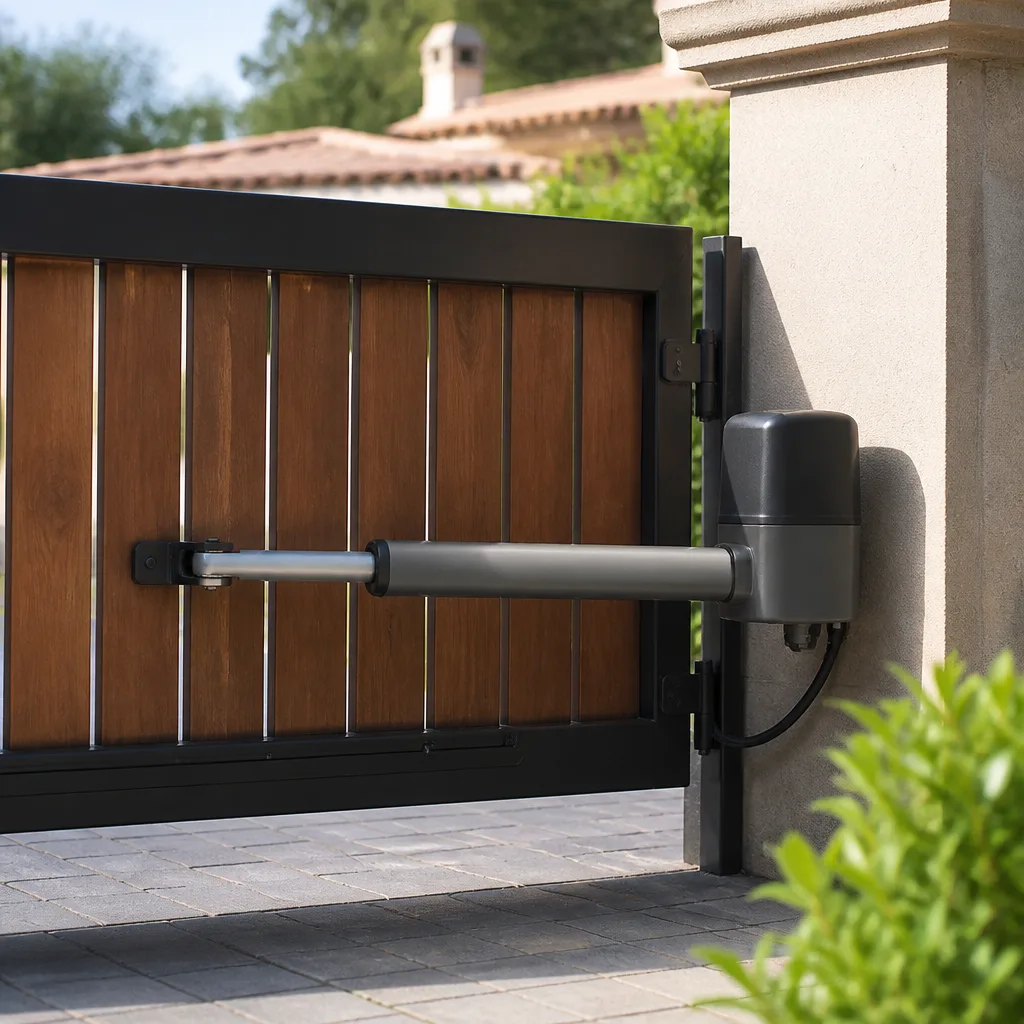
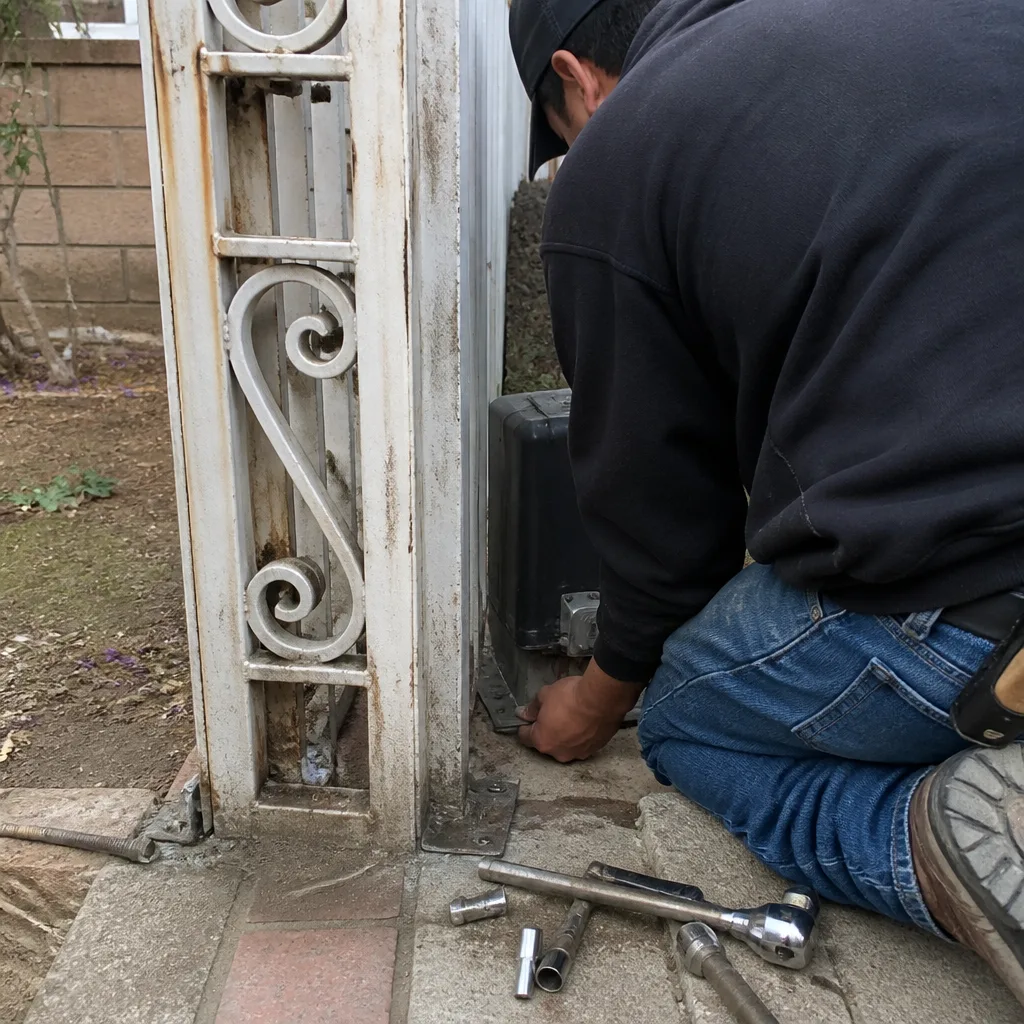 Before
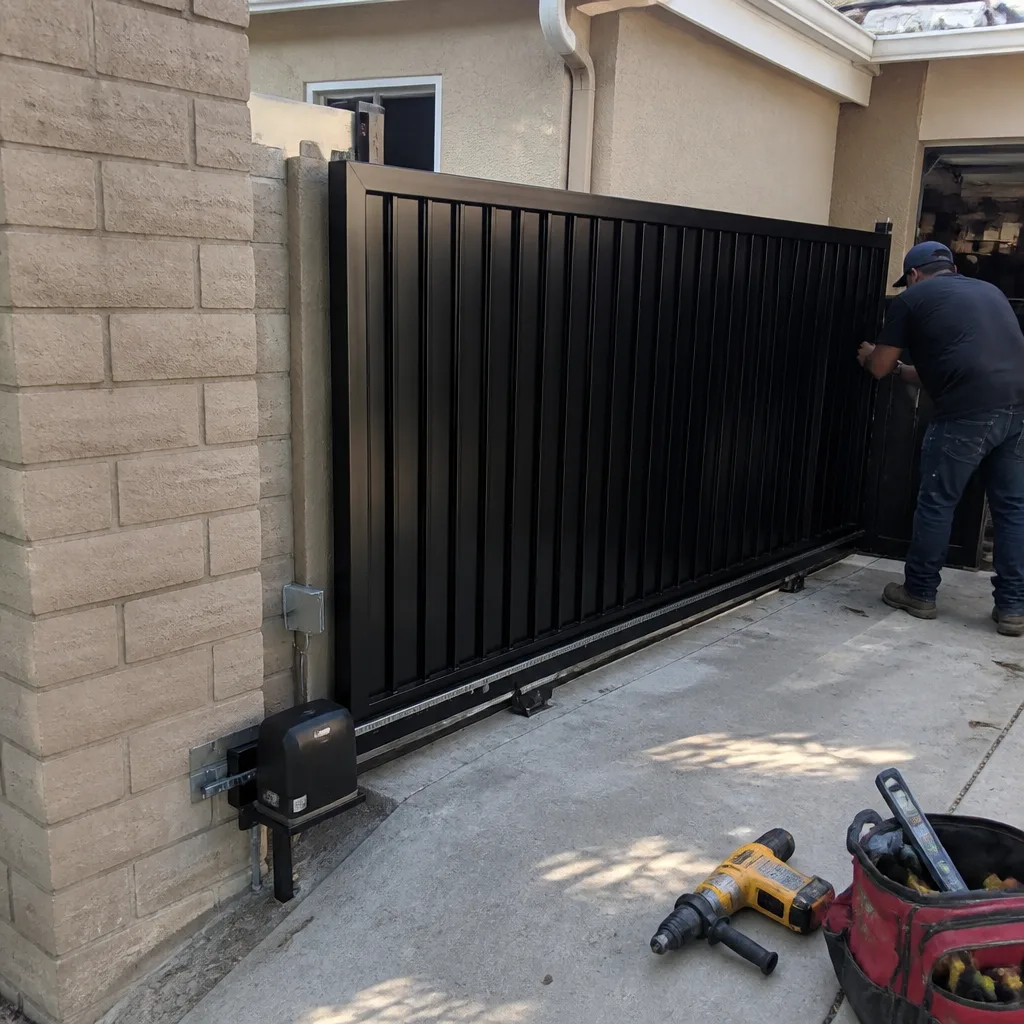 After
After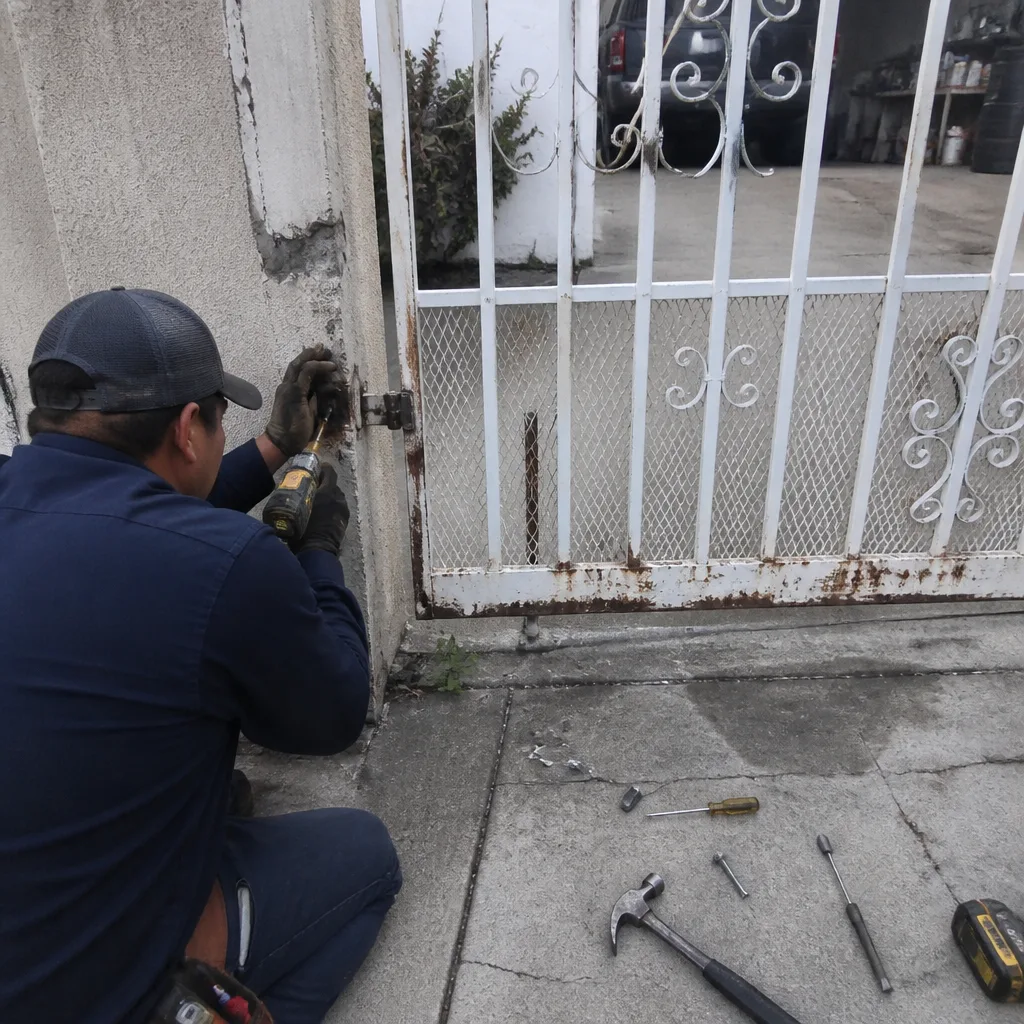 Before
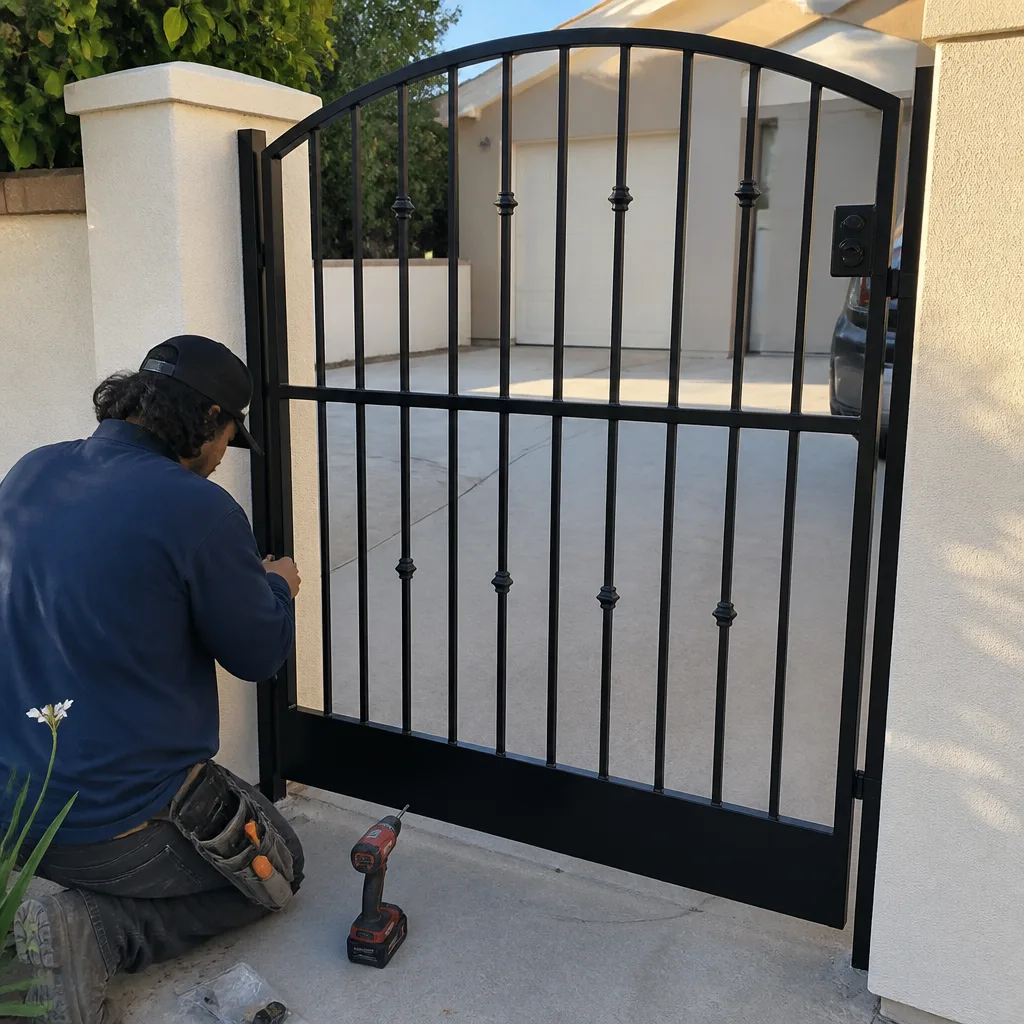 After
After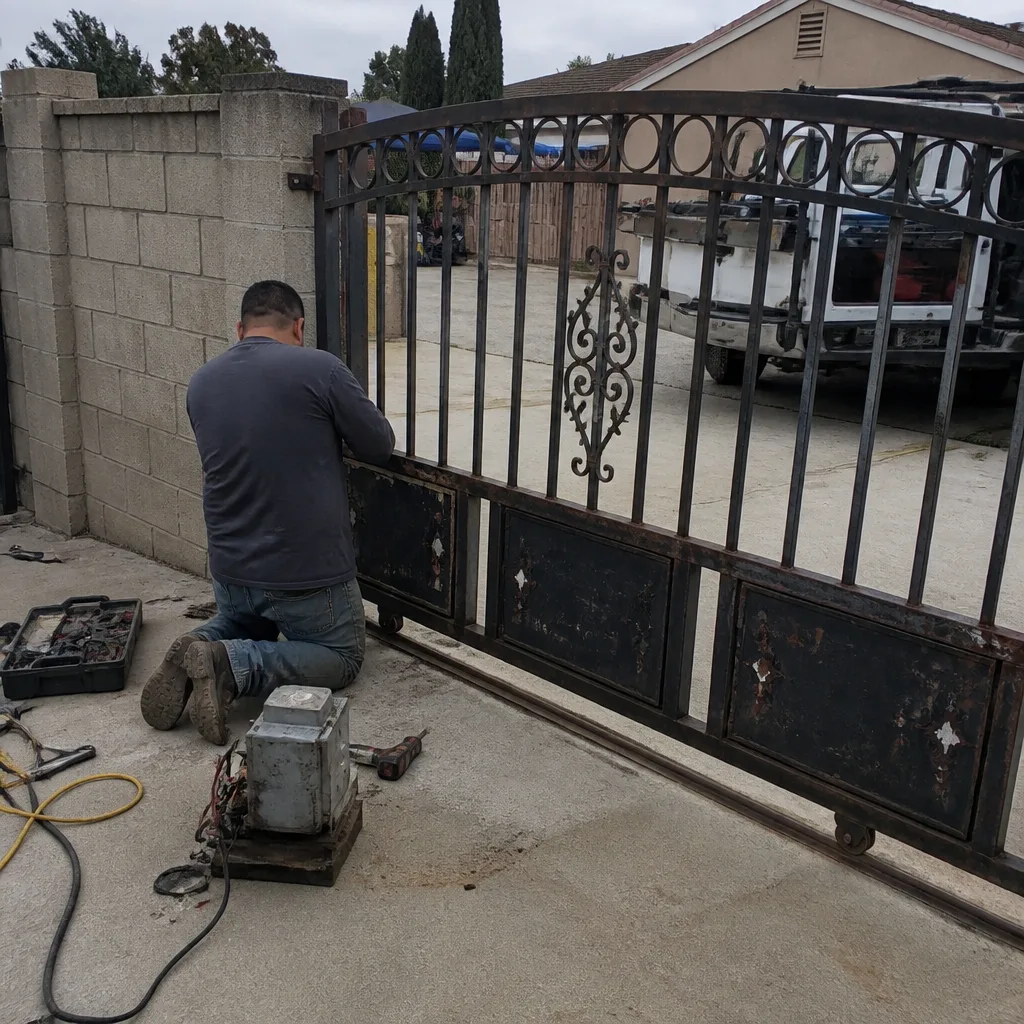 Before
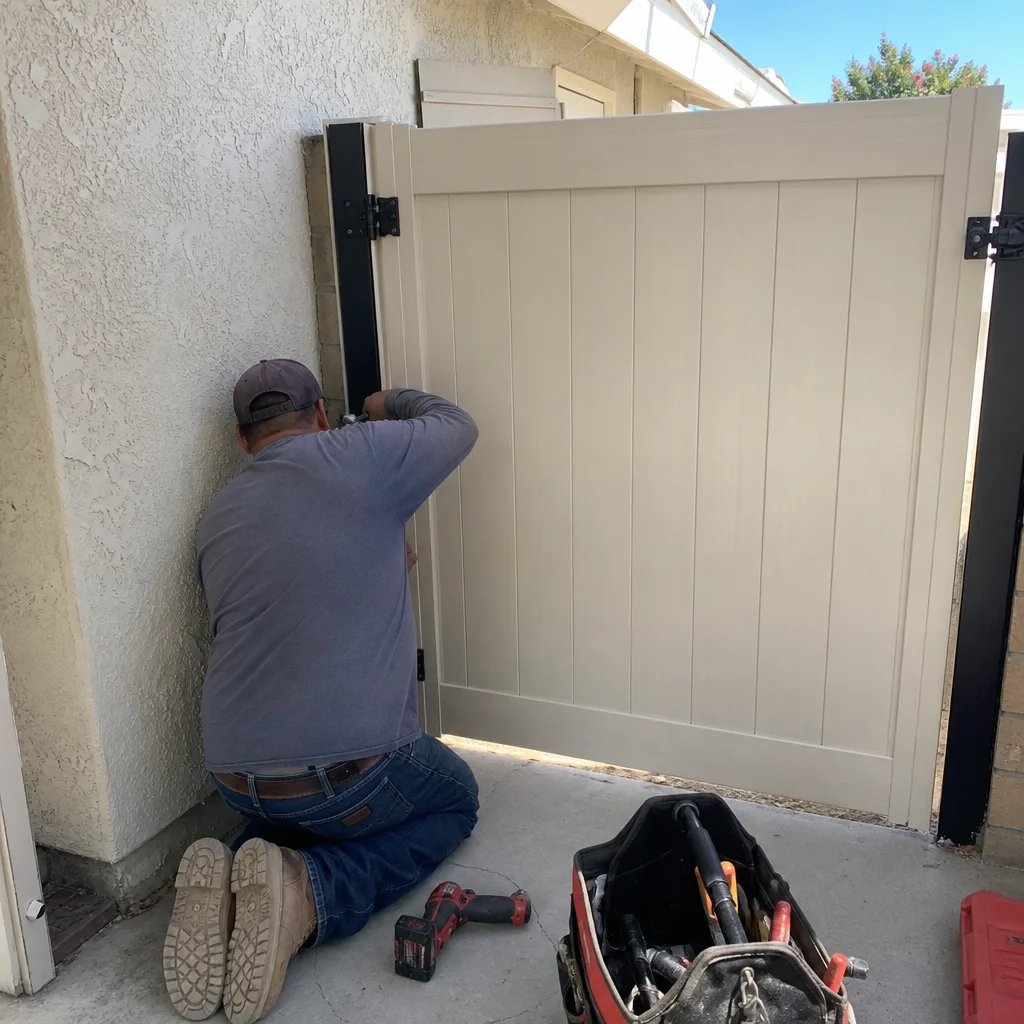 After
AfterSeasonal Gate Repair Care for Garden Grove: Year-Round Homeowner’s Guide
The gate that fails in January in Garden Grove almost always accumulated damage in October, during Santa Ana season, that a November inspection would have caught in ten minutes. This guide maps gate maintenance to Garden Grove’s actual climate calendar: Santa Ana wind loading, marine-layer corrosion, summer heat cycling, and irrigation overspray. For a deeper dive into local repair strategies, see The Complete Guide to Gate Repair in Garden Grove. You’ll learn what to check each month, what each check costs in time, and which problems demand a technician rather than a Saturday afternoon.
Quick Answer
Seasonal gate care in Garden Grove means inspecting four subsystems, hinges and track wheels, terminal connections and boards, operator thermal behavior, and ground-level hardware, on a schedule tied to local weather events rather than calendar seasons. A homeowner can handle visual inspections and simple lubrication monthly, but electrical work on any gate operator should be left to a trained professional. Most seasonal damage is preventable with about twenty minutes of inspection per month, and most Gate Repair services we perform could have been smaller if the owner had known what to look for.
Table of Contents
- Santa Ana Wind Loading: September Through November
- Marine-Layer Corrosion and Terminal Connections
- Summer Heat Cycling and Operator Thermal Cutoffs
- Irrigation Overspray: The Underreported Corrosion Source
- Garden Grove Month-by-Month Gate Care Map
- What a Homeowner Can Safely Do (and What to Leave Alone)
- Common Mistakes to Avoid
- When to Call a Professional
- Frequently Asked Questions
- The Bottom Line
BeforeAfterSanta Ana Wind Loading: September Through November
Santa Ana winds in Garden Grove don’t announce themselves the way a storm does. The sky turns clear, the humidity drops into single digits, and a sustained northeast wind starts pushing against the face of every gate in the city. For most of the year, wind speeds in Garden Grove average under 10 mph. During a Santa Ana event, sustained speeds of 25 to 40 mph are common, with gusts above 60 mph recorded in the flatter corridors running toward the coast. A swing gate that weighs 300 pounds acts as a sail during those events. The wind loads the hinge side unevenly, and every gust cycles the hinge pins through a flex pattern they don’t see on a normal day.
What actually fails after enough Santa Ana cycles depends on the gate style:
- Swing gates: hinge pin wear accelerates, the top hinge elongates first, the gate begins to sag toward the latch side, and the operator arm, whether it’s a LiftMaster LA400 or a FAAC 390, starts fighting a gate that no longer swings true. Every additional degree of sag increases the load on the operator motor.
- Slide gates: track wheels take the lateral force directly. In Garden Grove, where many slide gates use nylon or polyurethane wheels, the wind pushes the gate against the guide rollers and the wheels develop flat spots over a single season. A flat-spotted wheel transmits vibration into the chain or belt every time the gate moves.
- Cantilever gates: the counterbalance frame absorbs most of the wind load, but the truck assemblies carry more than their rated weight during gusts, and the wear appears as a slow drift in the gate’s closed position.
The ten-minute November inspection that catches this damage is simple. Open the gate fully. If it’s a swing gate, push on the latch corner and watch the top hinge. Movement you can see with your eye is movement that needs correction. If it’s a slide gate, run your hand along the track and feel for any wheel that doesn’t spin freely. And listen to the operator. A LiftMaster or BFT motor that strains audibly during the last third of travel is telling you the gate’s alignment has shifted. We see this pattern every year in neighborhoods across Garden Grove, from the older lots near Garden Grove Boulevard to the newer tracts east of the 22.
One correction we make repeatedly after the first strong Santa Ana of the season is resetting the open and close limits on operators. The wind pushes the gate past its set limit, the limit switch doesn’t update, and the operator now believes the gate is closed when it’s still two inches short. The fix takes a technician about ten minutes, but the homeowner who ignores it watches the gate drift further out of alignment every week until the auto-reverse starts tripping for no reason.
Marine-Layer Corrosion and Terminal Connections
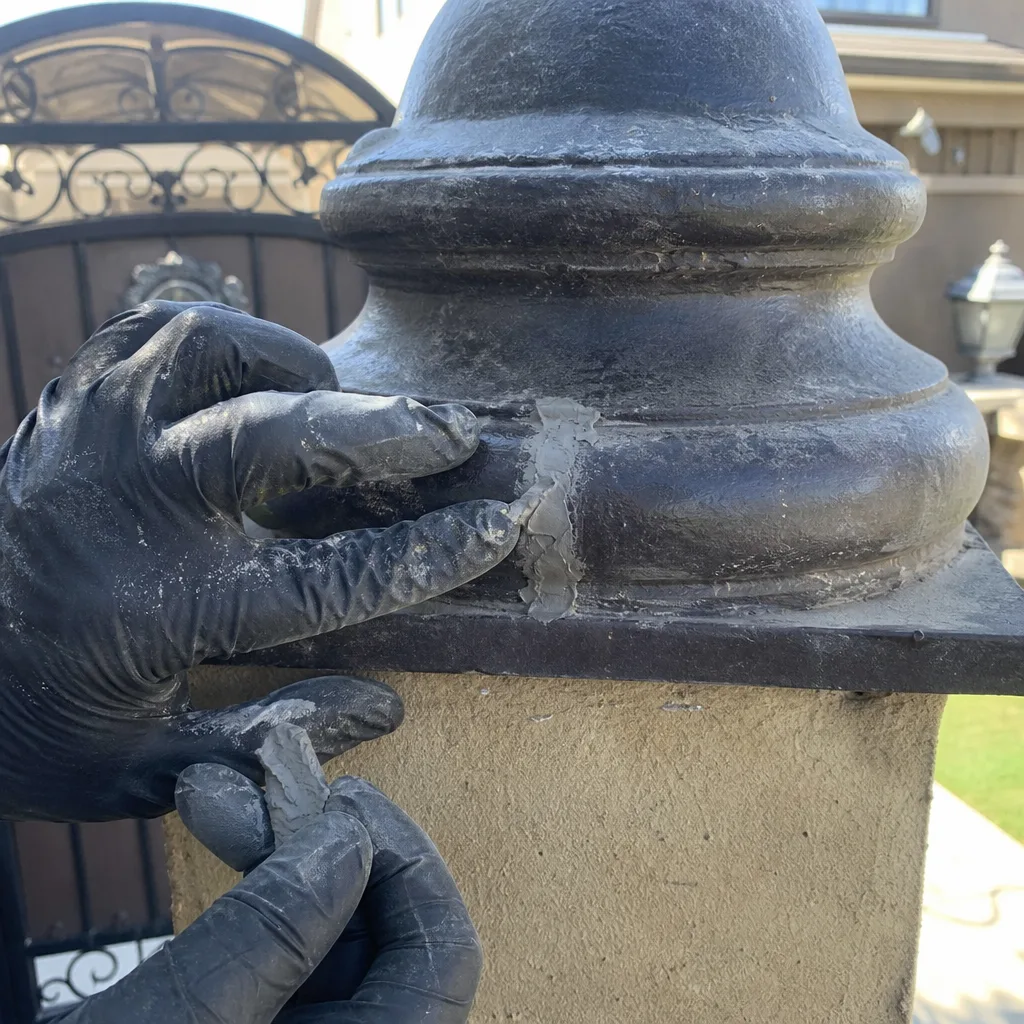
Garden Grove sits roughly eight miles from the coast, close enough that the marine layer reaches the city on most late-night and early-morning cycles between May and August. That air carries salt and moisture. It condenses on every exposed metal surface, and it finds its way into control boards, terminal strips, and wire connections that were dry all winter. The corrosion pattern is specific. It’s not the heavy rust you’d see on a beachfront property. It’s a fine white or green oxidation that forms on copper terminals, board traces, and spade connectors. It looks minor. It is not.
A Garden Grove gate operator board that has spent three summers absorbing marine-layer moisture develops pitting on the relay contacts and corrosion on the low-voltage terminal block. The symptom is intermittent. The gate works fine for a week, then faults out at 2:00 a.m. when the dew point spikes. The owner resets the breaker, the gate works for another five days, and the cycle repeats. What’s happening is that the corroded connections are building resistance. Resistance builds heat. Heat expands components. When the board cools, the connection reopens. It’s a textbook intermittent failure, and it’s the most common seasonal pattern we see on Gates with exposed boards in Garden Grove.
What to look for in your own box:
- Shut off the breaker to the gate operator before opening the control box.
- Look at the terminal strip where the low-voltage wires connect. White, green, or blue-green powder on any terminal is the start of corrosion.
- Check the board for any dull gray patches on the solder joints. Bright solder is healthy. Dull solder with a film on it has begun oxidizing.
- Look at the grounding lug. Corrosion here causes more phantom faults than any other single point.
If you find corrosion early, a technician can clean the terminals, apply a protective dielectric coating, and photograph the before-and-after. Under our documentation practice, also known as The Haven Standard, that photo record comes with every visit, which means next year’s inspection starts from a known baseline instead of a guess. If the corrosion has already eaten into the board, the fix may be a board replacement. On a LiftMaster or FAAC operator, that’s a $250 to $500 parts cost depending on the model, plus labor. Catching it a year earlier might have been a $100 terminal cleaning. That’s the economic argument for seasonal inspection.
Summer Heat Cycling and Operator Thermal Cutoffs
Garden Grove summer temperatures don’t just get hot. They cycle. A typical July day starts at 65°F before dawn and reaches 92°F to 96°F by mid-afternoon. A gate operator motor, control board, and capacitor all sit inside a housing that absorbs that full swing, and the housing temperature routinely exceeds the air temperature by 15 to 20 degrees. Any gate operator running its duty cycle during the hottest stretch of the day is operating near its thermal design limit. And in Garden Grove, the hottest stretch is also the busiest stretch for gate traffic, because that’s when every resident, delivery driver, and family member is coming and going.
The component that fails first is the thermal cutoff, normally a resettable or one-time device designed to interrupt power when the motor winding gets too hot. On a properly maintained operator with a clean bill of health, the thermal cutoff should never trip. That’s the point of it. But when the gate is slightly out of alignment, or the wheels need attention, or the hinges are binding, the motor works harder, runs hotter, and the thermal cutoff becomes the gatekeeper of last resort. The gate works all morning, dies at 2:00 p.m., and works again at 9:00 p.m. after the housing cools. The owner thinks the gate is “overheating because it’s hot outside.” The truth is the gate is overheating because something is making the motor pull more current.
What to check after an extended heat event in Garden Grove, a sequence of three or more days above 90°F:
- Run the gate three full cycles in a row at the hottest point of the day. If it faults on the third cycle, the margin is too thin and something has to change.
- Feel the operator housing. Warm is normal. Too hot to hold your hand against for ten seconds is a sign of an overworked motor.
- Listen for a change in motor pitch between cold morning operation and hot afternoon operation. A rising pitch under load indicates increased friction somewhere in the system.
We’ve replaced more capacitors after heat waves than any other single component on LiftMaster and Linear operators in Garden Grove. The capacitor stores the energy needed to start the motor, and it’s the part most sensitive to thermal stress. When it fails, the motor hums but doesn’t turn. The part itself is often under $100, but the diagnosis matters. A melted capacitor is a symptom of heat stress. Worn hinges, tight track wheels, and an undersized operator are the causes.
Irrigation Overspray: The Underreported Corrosion Source
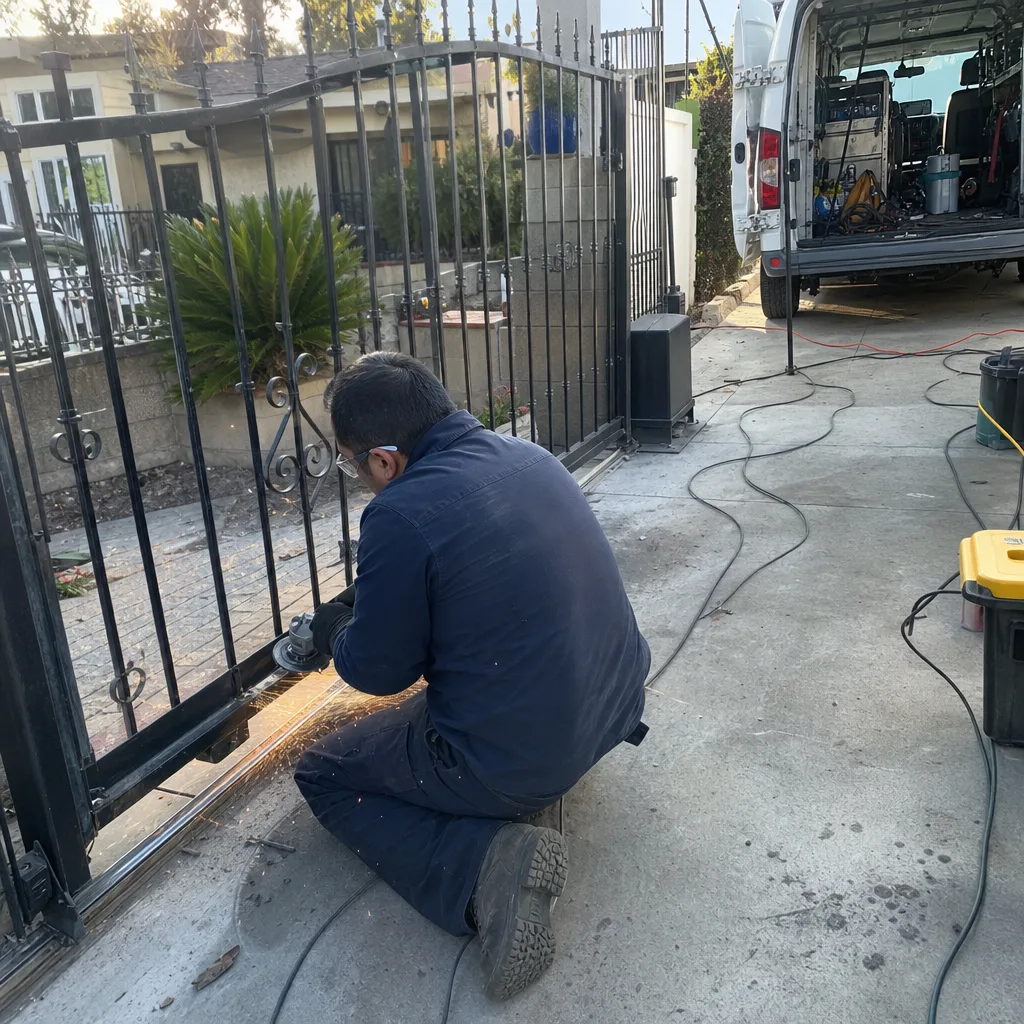
Walk through any Garden Grove residential neighborhood between 6:00 a.m. and 8:00 a.m. and you’ll see sprinkler heads throwing water onto lawns, sidewalks, and, in far too many cases, the base of a driveway gate. We call it irrigation overspray, and it’s the single most underreported cause of ground-level gate corrosion in Garden Grove residential installations. The water itself is bad enough. Irrigation water in Orange County is treated but it still carries dissolved minerals. When the water evaporates, it leaves those minerals deposited on steel and aluminum surfaces. Add the marine-layer humidity, and the corrosion environment is persistent: wet from sprinklers in the morning, wet from condensation at night, and mineral residue baking into the metal all day.
The components that suffer first are the ones at ground level:
- Slide gate track and track brackets: rust forms on the inner surface where the wheels run, and the wheels pound the rust into the metal with every cycle. The track develops pitting, and the pitting becomes a new friction point that wears wheels prematurely.
- Gate wheel and bearing assemblies: the seals fail first, then the bearings. A wheel that runs quietly for years can go loud in a single season if the bearing grease is washed out by a misaligned sprinkler head.
- Bottom hinge pins on swing gates: they sit in the splash zone, and they corrode from the inside out. The gate becomes harder to operate, and the operator motor picks up the extra load.
- Photo-eye sensors mounted low on the gate posts: water intrusion into the housing clouds the lens and eventually shorts the sensor.
The fix is often as simple as redirecting a sprinkler head. We tell Garden Grove homeowners to stand at the gate at the time the sprinklers run and watch where the water actually goes. If any water touches the gate, the track, the wheels, or the sensor housings, adjust the head. The second layer of protection is coating the exposed metal with a corrosion inhibitor once a year, which we do as part of seasonal maintenance calls and document in the photo log. A homeowner who does both, redirects the water and maintains the coating, can extend the life of gate hardware by years in Garden Grove’s climate.
Garden Grove Month-by-Month Gate Care Map
Calendar seasons don’t align with Garden Grove’s actual stress patterns. Here is the month-by-month map, matched to what actually happens to gate hardware in this city.
January and February: Rain and Recovery
This is the season when January failures reveal October damage. Rain saturates the soil around gate posts, and if a post has shifted even an inch during Santa Ana season, the gate jams and the operator faults. The soil in much of Garden Grove is a sandy loam that drains reasonably well, but the older neighborhoods with compacted clay soil hold water longer, and posts in those areas shift more. Check gate operation after any rain event of more than one inch. Listen for new straining sounds from the operator. Check the low points of the track for standing water.
March and April: Post-Rain Realignment
The ground has settled. Gates that got through the rainy months with extra friction need realignment now, before summer heat makes everything worse. This is the right window for hinge adjustment, track leveling, and limit switch resetting. If you schedule one professional maintenance visit per year in Garden Grove, this is the window to schedule it, because it corrects winter damage before summer heat amplifies it.
May and June: Morning Condensation Begins
The marine layer becomes a nightly visitor. Check the inside of your operator housing on a morning when everything outside is wet. If the inside walls of the housing are damp, the housing needs better ventilation or sealing. Check the desiccant pack if your operator has one. A saturated desiccant pack is doing nothing. Most Garden Grove gate operators we service need a desiccant replacement or a vent improvement by their third year in the field.
July and August: Heat Abatement
The gate runs hard and the sun is at its most direct. Shade the operator housing if possible. A south-facing or west-facing metal housing in Garden Grove can exceed 130°F internally on a 95°F day. That’s beyond the operating temperature of most control boards. A simple shade panel can drop the internal temperature by 15 degrees and extend the life of every electronic component inside. We’ve helped customers in Garden Grove’s newer developments, where homes face the afternoon sun without mature tree cover, add shade screening over operator boxes to prevent summer shutdowns.
September Through November: Santa Ana Season
This is the critical inspection window we started with. Before the first major Santa Ana, inspect hinges, wheels, track bolts, and limit settings. After each strong event, recheck. The wind doesn’t damage gates in a single event. It applies thousands of small stress cycles, and the damage accumulates. A November inspection that finds worn hinge pins, flat-spotted wheels, or stretched chains is finding damage that can be fixed at scheduled-maintenance cost instead of emergency-repair cost.
December: Pre-Rain Preparation
Before the winter rains arrive, seal any gaps in the operator housing, verify that the auto-reverse and photo-eye sensors are working, and lubricate all pivot points with the right product. In Garden Grove, a dry winter can transition to a wet one within a week. The gate that’s prepared in December is the gate that works through January without a service call.
What a Homeowner Can Safely Do (and What to Leave Alone)
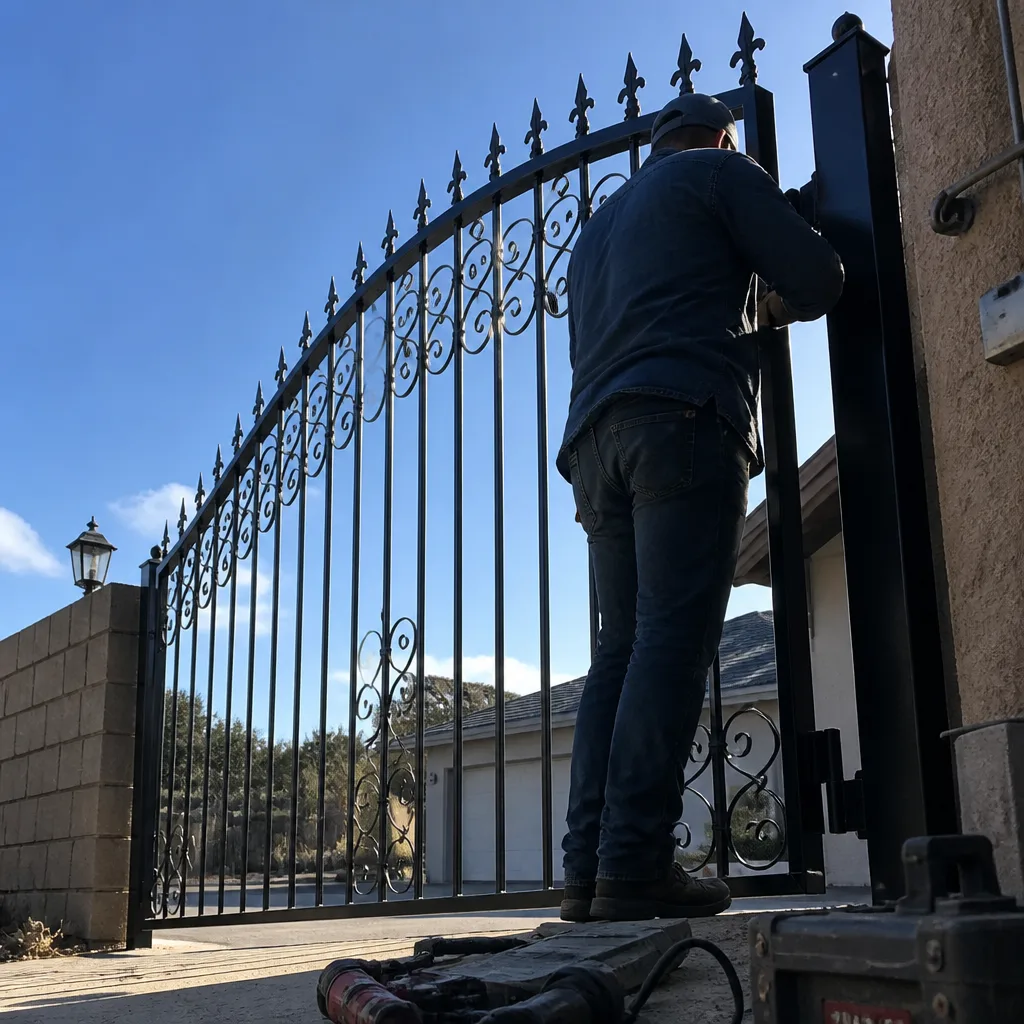
We are direct about this because it matters. A gate operator has enough mechanical force to injure or kill, and several components hold stored energy even when the power is off. Here is the line.
Safe for a Homeowner:
- Visual inspection of hinges, track, wheels, and hardware
- Cleaning debris from the track and from the gate base
- Lubricating pivot points with a non-petroleum lubricant designed for gate hardware
- Verifying that the auto-reverse function works by placing a solid object in the gate’s path and running a cycle
- Checking for sprinkler overspray and redirecting heads
- Photographing anything that looks worn or odd so a technician can assess it
Leave to a Professional:
- Any work on a tension-loaded gate spring, which stores immense energy and can release catastrophically
- Opening a control box and touching any wiring, even with the breaker off, if you’re not trained in low-voltage electrical work
- Adjusting hydraulic closer valves or operator limit cams, which require specific torque settings
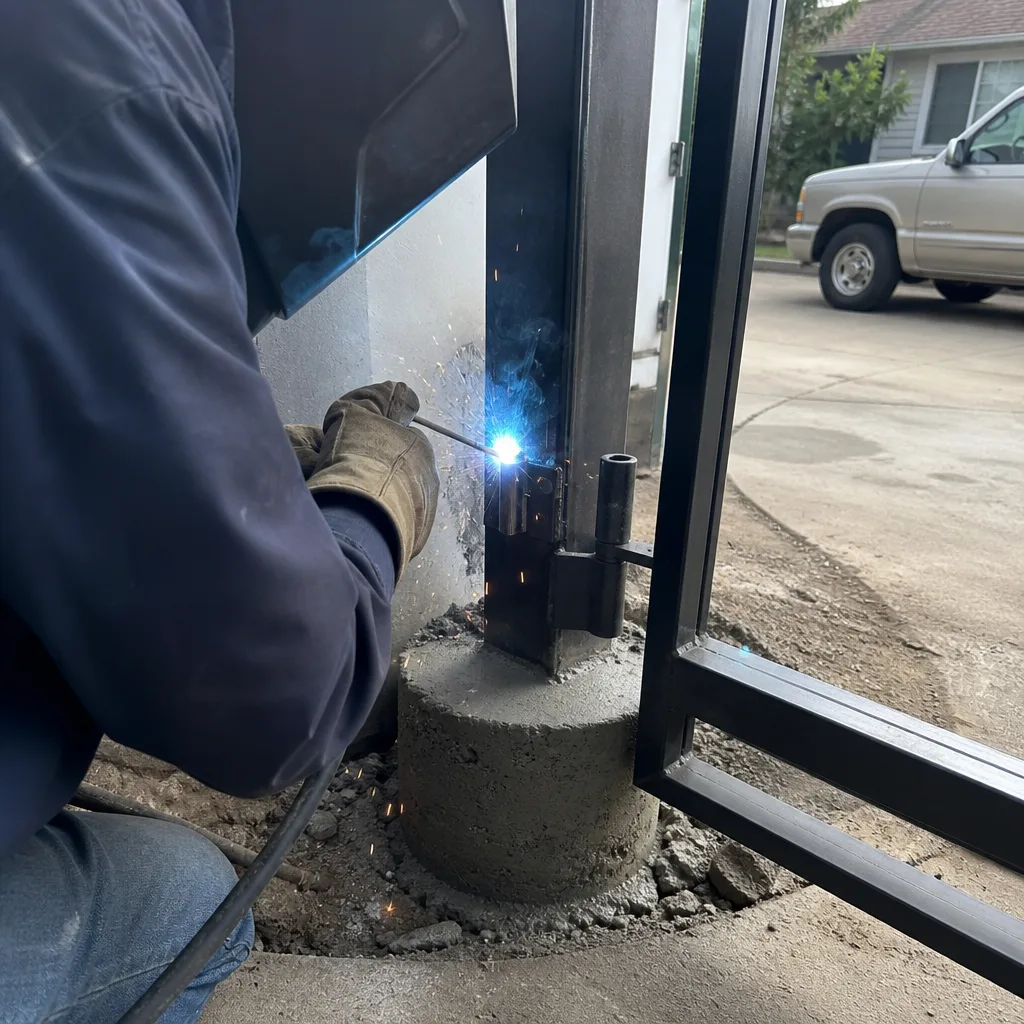
- Welding or structural repair on the gate frame
- Any repair where the gate is off its track or hanging from a single hinge, which requires mechanical lifting equipment and stabilization
If a gate component is on this second list and you’re seeing symptoms, call a trained professional. The injury risk is real, and the cost of a service call is trivial compared to the cost of an accident. Our own technicians at Vance Gate Repair Garden Grove are background-checked and uniformed, and every job begins with a written price before any work starts, because the homeowner deserves to know the number before a tool comes off the truck. Not sure whether to DIY or call us? Read DIY vs Professional Gate Repair: The Garden Grove Homeowner’s Decision Guide.
Common Mistakes to Avoid
- Lubricating the wrong parts. Grease on a slide gate track attracts dust and grit in Garden Grove’s dry season. The correct lubrication points are hinge pins, wheel bearings, and pivot joints, using a product designed for gate hardware, not WD-40.
- Ignoring a gate that’s “a little slow.” Slow operation is not a personality trait. It’s friction, and friction on a gate always increases. The gate that runs slow in October will fault out in January.
- Repainting over corrosion without surface prep. Painting over rust traps the corrosion and lets it spread underneath. The metal has to be cleaned, treated, and primed first, and in Garden Grove’s marine-layer climate, the paint needs to be a product rated for coastal exposure.
- Adjusting the limits to fix a mechanical problem. When a gate sags or a chain stretches, the operator’s first symptom is often that the gate doesn’t close all the way. Adjusting the limit switch to “fix” that masks the mechanical problem while it gets worse. A limit adjustment is a calibration, not a repair.
- Letting sprinkler overspray continue for years. There is no gate hardware that’s immune to mineral-laden water hitting it every morning. The fix is free, you redirect the sprinkler. The failure, when it comes, is not.
- Attempting to tension a gate spring without training. This is the single most dangerous act a homeowner can perform on a gate. Gate springs hold forces that can take fingers, break bones, and worse. If a spring is loose, broken, or sagging, the correct action is a service call.
- Assuming a modern operator doesn’t need seasonal attention. The newest LiftMaster, FAAC, BFT, and Linear operators are built well, but Garden Grove’s climate doesn’t care. Marine-layer corrosion and heat cycling stress every electronic component regardless of when it was manufactured.
When to Call a Professional
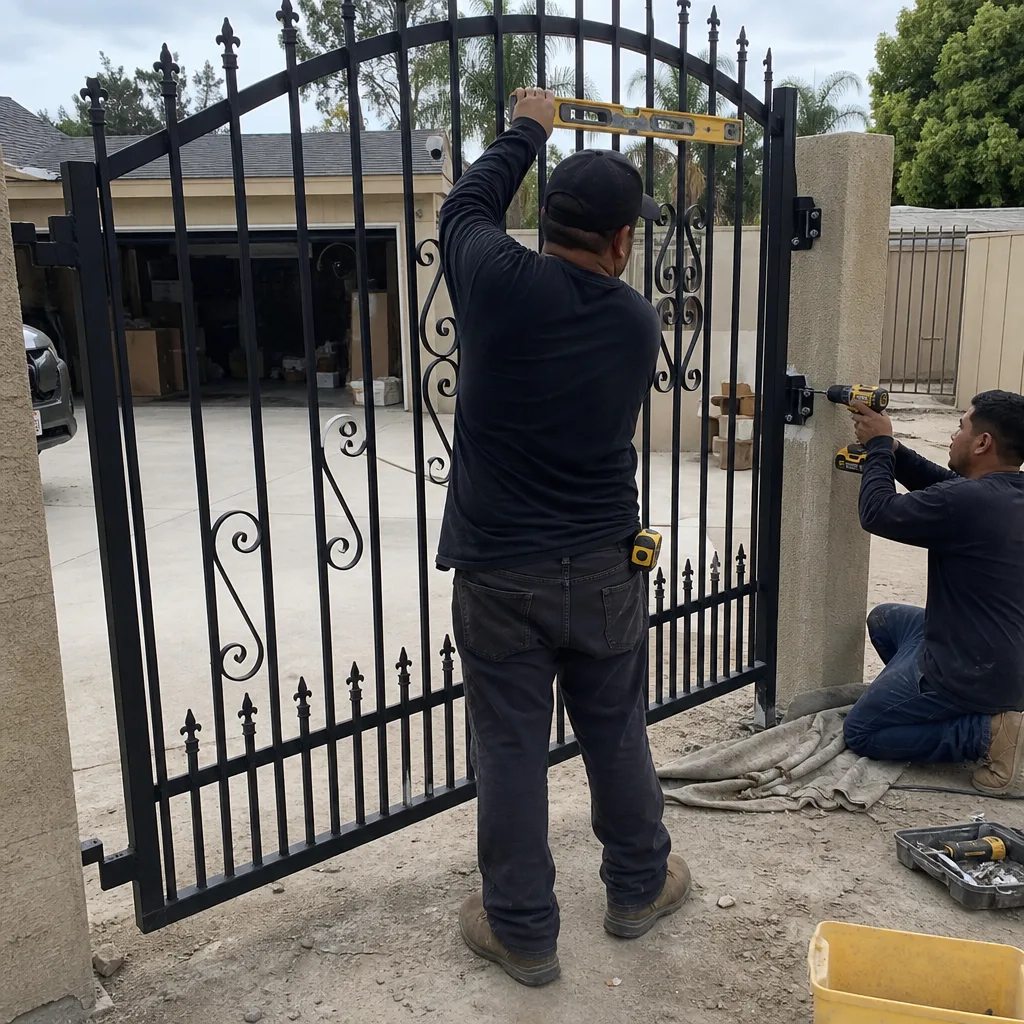
Call a gate professional when the auto-reverse fails to engage, when the gate is visibly sagging or dragging on the ground, when the operator runs but the gate doesn’t move smoothly, when you see exposed wiring or corroded terminals inside the control box, or when the gate has come off its track entirely. These conditions indicate structural or electrical problems that require tools, training, and in some cases lifting equipment.
Vance Gate Repair Garden Grove offers free estimates in Garden Grove. Call (657) 837-6867. We arrive with a written price before any work begins, and every visit includes a documented photo record so you can see exactly what we found and what we changed. If you have a written estimate from another company, bring it and we’ll review it at no cost for a second opinion.
Frequently Asked Questions
A standard seasonal gate maintenance visit in Garden Grove typically runs between $125 and $250 for a single swing or slide gate, including hinge and track inspection, limit switch verification, lubrication, and minor adjustments. More extensive work, like replacing a control board or rebuilding a hinge, is quoted separately and in writing before any work begins. Call (657) 837-6867 for a free estimate on your specific gate.
The best window for an annual gate inspection in Garden Grove is March or April, after winter rains have revealed any post shifting and before summer heat stress begins. A secondary inspection in October or November catches Santa Ana wind damage before it becomes a January failure. Both windows matter for different reasons.
Afternoon shutdowns during Garden Grove’s hot season are usually caused by thermal cutoffs tripping on an overheated motor, not by the heat itself. The motor is running hotter because something is increasing friction, often worn hinges, a binding track wheel, or a poorly lubricated pivot. The fix is correcting the mechanical issue, not waiting for the operator to cool down.
Yes. Redirecting a sprinkler head so it doesn’t hit your gate, track, or sensor housings is a straightforward homeowner task that requires no special tools beyond what’s needed to adjust the head. Do it before the irrigation season begins in Garden Grove, and recheck after any landscaping changes. This one fix extends the life of gate hardware more than any product you can buy.
We service LiftMaster, FAAC, BFT, Linear, Viking, Ghost Controls, DoorKing, Elite, and Mighty Mule operators in Garden Grove. If your gate already has a motor from one of these brands, we can diagnose and repair it without steering you toward a replacement you don’t need. The brand doesn’t determine the service; the condition does.
If your gate is still in its track or on its hinges but making noise or moving poorly after a Santa Ana event, stop using it and schedule a professional inspection. A gate that’s come off its track or dropped onto one corner needs professional handling; the components are under load and attempting to lift it back into place without the right equipment is risky. Call (657) 837-6867 in Garden Grove for a same-day assessment during Santa Ana season.
The Bottom Line
Garden Grove gates don’t fail randomly. They fail on a schedule, and the schedule is written in the city’s weather patterns. Santa Ana season stresses hinges, wheels, and limit settings. Marine-layer humidity corrodes terminals and boards. Summer heat cycles push operators to their thermal limits. Irrigation overspray eats ground-level hardware year-round. Each stressor has a season, and each season has an inspection task that catches the damage while it’s still cheap to fix. Twenty minutes a month, plus one professional maintenance visit in spring and one pre-Santa Ana inspection in fall, keeps a Garden Grove gate running for years instead of failing during the worst week of the year. For more guides & resources on protecting your gate, explore our blog.
If your gate needs professional attention, our Gate Repair in Garden Grove service covers everything from hinge rebuilds to full operator replacement. For homeowners planning a new gate, see our Gate Installation in Garden Grove page. If the motor or opener is the problem, our Gate Motor & Opener in Garden Grove page explains what we service and how we price it. You can also visit our Vance Gate Repair Garden Grove home page to see the full range of what we do.
Call (657) 837-6867 for a free estimate. The price is written before anyone picks up a tool, and the photo record is handed to you when the tech leaves. That’s how every job works here.
Written by Adrian Vance, Owner at Vance Gate Repair Garden Grove, serving Garden Grove since 2014.